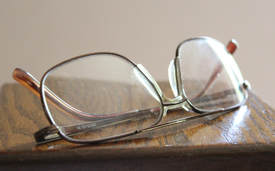
There was a note on the kitchen table. Fix Dad’s glasses. “Did his glasses fall apart again?” I asked Mike. “Yep.” “What happened this time.” “I don’t know. The lens fell out.” I looked at the glasses. “You mean both lenses fell out,” I said. Mike came over to look. “What?? I just had the technician put on bolts to the screws to keep them in longer!” “I think Dad may have undone them, although where he got a screwdriver to do it, I have no idea.” “No, he just keeps stepping on them. There’s no way he could see and concentrate to do that.” And so Mike took Dad’s glasses in for another repair. We talked about maybe not bothering with his glasses anymore since he can’t read and doesn’t watch TV (the remote is too complicated for a dementia patient). But he does need them to be able to see his plate when he’s eating a meal. That lasted for about a month. Dad breaking them, Mike taking them in to be fixed. And just as suddenly as it started, it stopped. Then some other behavior changed that we had to problem-solve. And so it goes with caregiving for a dementia patient. You barely have time to get your bearings, when the problems change and you need a new strategy. Never a dull moment. March 3, 2025 - added note: Dementia and driving can be complicated. Obviously, as the condition worsens, those with dementia will have to stop driving. Warner Law Offices made a guide that detailed the laws behind dementia and driving: signs of unsafe driving, how to talk to a person about quitting driving, and how a person with dementia can still maintain some independence. Perhaps you find yourself in this situation. If so, check out this free resource at: Dementia and Driving - wvpersonalinjury.com/dementia-and-driving/ Comments are closed.
|
Archives
July 2024
Donna KemperDonna Kemper put aside her art career to care for a mother she hadn't seen in over a decade. For seven years she followed her mother's journey into dementia, caring for her and putting forgiveness into action. Categories
All
|

RSS Feed